How DX accelerates CTO onboarding

Greyson Junggren
Co-founder, CRO
Stepping into a new CTO role is one of the most consequential transitions in a technology leader’s career. You’re now accountable for the technical direction of the entire organization, responsible for aligning engineering strategy with business objectives, and expected to deliver measurable results while building and scaling high-performing teams.
In 2026, this responsibility extends to navigating the evolving AI landscape: making strategic decisions about AI investments, measuring their impact, and ensuring these tools deliver genuine productivity gains rather than just adding to the technology stack.
The challenge is immediate and unforgiving: boards and executives expect you to quickly assess the current state, identify opportunities and risks, and articulate a clear vision for the future. You’ll face questions like “What’s our ROI on AI coding assistants?” and “Where are our biggest productivity bottlenecks?” within your first few weeks, often before you’ve had time to build a complete picture of the organization.
Traditionally, answering these questions has meant spending your first 90 days in discovery mode: conducting countless one-on-ones, analyzing fragmented data sources, and piecing together an understanding of organizational dynamics, team capabilities, and technical debt. But, often, CTOs don’t have the luxury of a lengthy ramp-up period.
With DX, you don’t have to choose between speed and depth of understanding. You can access comprehensive, data-driven insights from day one, allowing you to move quickly from assessment to action. Here’s how DX empowers new CTOs to establish credibility, make informed decisions, and drive meaningful impact from the start.
Get the lay of the land quickly
One of the most critical imperatives for a new CTO is developing a comprehensive understanding of the organization: its technical capabilities, team dynamics, productivity bottlenecks, and cultural factors that influence execution.
In 2026, this also means assessing how AI tools are being adopted across teams and whether these investments are delivering the promised productivity improvements or creating new sources of friction. Traditionally, gaining this context requires weeks or months of meetings, one-on-ones, and manual data gathering.
With DX, you can establish a data-driven baseline of your organization from day one. Here’s how:
- The ground truth straight from your developers: DX’s developer surveys average a 96% participation rate, providing you with statistically reliable insights that reflect the authentic voice of your teams.
This high engagement means you’re working with representative data, including feedback on AI tool effectiveness, adoption barriers, and developer sentiment. This enables you to make decisions with confidence rather than relying on anecdotal evidence or incomplete information. - Team-level metrics and insights: Quickly understand each team’s unique challenges, concerns, and productivity barriers. DX surfaces specific comments and feedback from team members, providing actionable intelligence that would typically take months to gather.
You’ll immediately see which teams are successfully leveraging AI tools, which are encountering adoption challenges, and where workflow friction is impacting delivery. - Industry benchmarking: DX’s granular benchmarking capabilities allow you to contextualize your organization’s performance against industry standards, identifying both competitive advantages and areas requiring improvement, including how AI adoption and impact compares to peer organizations.
Rather than spending your first quarter in discovery mode, you can begin your tenure with comprehensive insights into team dynamics, productivity patterns, and key challenges. Within your first week, you can identify your top three priority areas and begin formulating your strategic response.
Report on the state of engineering to the CEO and board
As a new CTO, you’ll be expected to present a comprehensive assessment of engineering’s current state and articulate a strategic vision for the future. But establishing credible baselines and communicating about productivity is complex. Questions like “what are the right metrics?” or “where is engineering capacity being allocated?” require nuanced answers.
In 2026, you’ll also face increasing scrutiny around AI investments: “What’s our return on AI coding assistants?” and “How are these tools actually impacting developer productivity and code quality?”
DX’s answer: the Core 4 framework
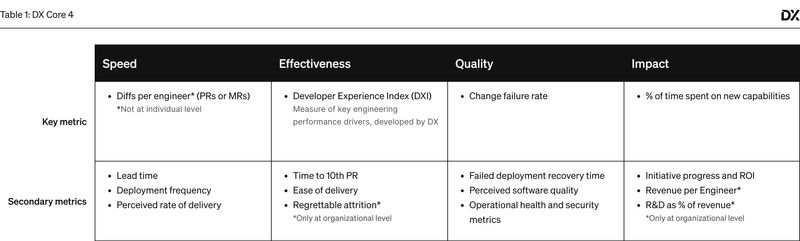
The DX Core 4 framework measures engineering productivity across speed, quality, effectiveness, and business impact, providing a balanced view that aligns with established frameworks like DORA, SPACE, and DevEx. Core 4 establishes clear baselines for tracking progress and simplifies executive reporting, making it easier to demonstrate engineering’s business impact and align technical initiatives with organizational objectives.
With Core 4, you can walk into your first board meeting with credible data on engineering performance, clear benchmarks against industry standards, and a roadmap for improvement. You’ll be able to answer tough questions about capacity allocation, productivity trends, and AI tool effectiveness with data rather than assumptions.
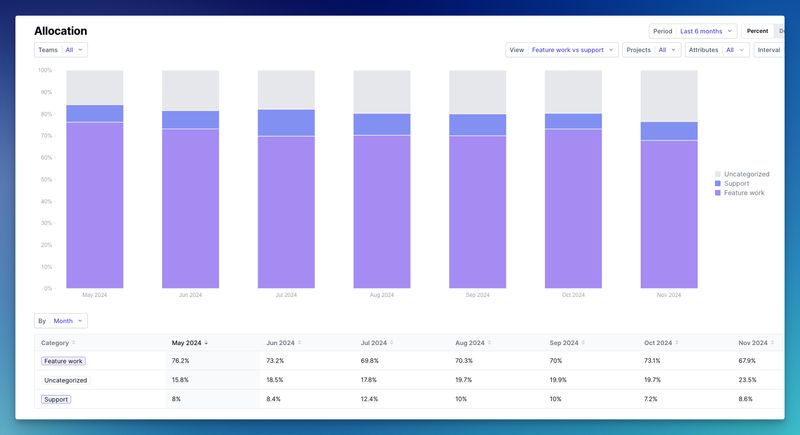
DX also helps you answer one of the most common executive questions: “Where is engineering capacity being allocated?” Quarterly snapshots provide clear visibility, capturing the percentage of time invested across different areas and delivering visual breakdowns of team allocation data, including capacity saved or consumed by AI tooling, time spent on technical debt versus new features, and how allocation compares to strategic priorities.
Measuring AI’s impact
With AI tools now representing significant capital allocation in engineering budgets, boards and executives expect rigorous analysis of returns. DX provides the measurement framework to answer critical questions with precision:
- Adoption metrics: Track which teams are actively using AI coding assistants and identify organizational barriers to adoption
- Productivity impact: Measure whether AI tools are delivering measurable improvements in speed and effectiveness, or if they’re introducing new challenges that offset potential gains
- Developer sentiment: Understand how developers perceive AI tools. Are they enhancing the development experience or creating frustration and workflow disruption?
- Quality implications: Monitor whether AI-generated code maintains quality standards or introduces technical debt and security vulnerabilities
These insights allow you to make informed decisions about AI strategy, like whether to expand investment, adjust implementation approaches, or redirect resources to higher-impact areas.
Identify struggling teams or individuals
As a new leader, rapidly identifying areas requiring intervention is essential. Specific teams may be struggling due to project complexity, resource constraints, technical debt, or challenges adapting to new AI-assisted workflows. Without comprehensive visibility, determining where to focus your attention and resources can be challenging.
DX provides at-a-glance views into team and individual performance. Heatmaps deliver an overview of where different teams are excelling or encountering difficulties, whether from delivery challenges, quality issues, or AI adoption friction:

Detailed metric breakdowns provide ready-to-use reports on key metrics like DORA, cycle time, and throughput, organized by team and individual:

These insights help you quickly identify teams that would benefit most from additional support, training, or process improvements. You can pinpoint where AI tools are creating unexpected friction and determine whether the issue is technical, cultural, or related to implementation approach.
With DX’s insights, you can allocate your time and resources where they’ll have the greatest impact, positioning your teams for success and ensuring operational excellence across the organization.
Within your first 30 days, you’ll have a clear picture of which teams need immediate intervention, which are performing well and can serve as models for others, and where strategic investments will yield the highest returns.
The first 90 days of your CTO tenure will define your trajectory and set the tone for your leadership. The traditional approach of spending months gathering context through meetings and one-on-ones leaves you reactive rather than strategic.
DX fundamentally changes what’s possible in those critical early days. You’ll have comprehensive, actionable intelligence from day one. You can walk into your first board meeting with credible data, identify your top priorities within your first week, and begin driving meaningful organizational change within your first month, all while making informed, strategic decisions about AI investment and implementation.
The difference between a successful transition and a struggling one often comes down to timing. Having comprehensive insights in month three doesn’t help when critical decisions need to be made in week two. Your ability to lead effectively from day one—when expectations are highest and your decisions carry the most weight—depends on having the right data at the right time.
To learn more about how DX can accelerate your impact as a new technology leader, request a demo today.