Customer spotlight: Inside Dropbox’s developer productivity playbook

Kali Watkins
Product Marketing
We recently hosted a customer spotlight with Jason Silver and Kazu Okumura from Dropbox, where they walked through how they built a developer productivity program anchored in the DX Core 4, paired it with an AI adoption initiative, and increased their DXI by 7 points in 12 months. They also cut PR cycle time in half, increased PR throughput by 50%, and made an 11‑point gain on documentation satisfaction.
This article summarizes how Dropbox approached their developer productivity program, what they changed in their first year, and the lessons they shared for other teams using DX.
Aligning leadership around the DX Core 4
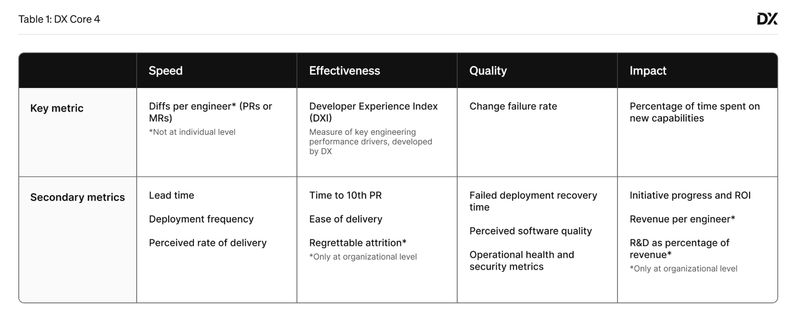
When Silver stepped into the developer productivity PM role, leaders across Dropbox had different mental models for “developer productivity.” The team anchored on DX Core 4 and DXI as the shared framework, setting a goal to move DXI from 60 to 65 within a year based on industry benchmarks.
With strong CEO and CTO sponsorship, this framework and its measurable targets turned DXI and Core 4 metrics (including PR throughput and cycle time) into shared outcomes for engineering leadership, rather than side‑channel reporting.
Where Dropbox focused to move DXI
PR throughput and cycle time
Dropbox focused early on speed, using DX data to make PR throughput and cycle time visible and meaningful across the organization. Within nine months, they cut PR cycle time and increased PR throughput by 50%. These improvements pushed Dropbox past P90 industry benchmarks and contributed directly to the DXI gain.
Documentation
Documentation had been Dropbox’s top pain point for developers for years. Silver approached it as a socio‑technical problem: tools matter, but so do expectations and visibility.
Two changes made the biggest difference. First, they improved the internal developer portal where durable docs live in code, making it easier for engineers to find reliable documentation. They then ran a company‑wide “docuthon”: a dedicated day to refresh stale docs, fix broken links, and close documentation tickets, with progress tracked and shared in real time.
To make this stick, Dropbox also introduced ongoing expectations, such as SLAs to refresh top docs every six months, so that documentation quality wasn’t just a one‑day push. These efforts led to an 11‑point increase in documentation satisfaction in DX and a sense of shared ownership over docs.
AI adoption and impact
In parallel, Okumura led Dropbox’s AI enablement efforts. In early 2025, AI usage among engineers was below 30%. With strong executive backing and coordinated work across engineering productivity, legal, security, and enablement, they drove AI adoption to 80% in 30 days and reached and maintained 95–100% usage by the end of the year.
Using DX, they segmented developers by AI usage and compared PR throughput, cycle time, and DXI across usage cohorts. Heavy AI users showed clear gains in throughput and velocity, especially as agents became more widely used. Rather than treating AI as a separate track, Dropbox measured AI’s impact through the lens of the DX Core 4, looking at speed, effectiveness, quality, and impact.
Dropbox also saw an AI maturity gap: some engineers were pushing hard on agents, while many still primarily used autocomplete. The next phase of their program is a focused push on agents as part of concrete workflows, backed by targeted enablement and DX‑based metrics to track impact.
As Dropbox expands AI-driven development, Okumura emphasized that they are applying the DX Core 4 framework with clear guardrails around review times and quality, not just speed and throughput. As PR volume increases, Dropbox is closely managing product stability to ensure quality does not erode as velocity rises. By actively monitoring developer activity and trends across these metrics, the team is taking a proactive approach to debugging and resolution, rather than waiting to react after downstream outcomes appear.
Additional lessons from Dropbox’s first year with DX
Dropbox’s experience surfaced a few themes that may be useful for other teams using DX:
Pair top‑down mandates with bottom‑up ownership. Strong CEO/CTO sponsorship made DXI and speed metrics a company priority, but change only stuck because VPs, EMs, and the People team were pulled in as co‑owners. Central platform and productivity teams set direction and provided data; individual groups owned their slice of the outcomes.
Build credibility by sharing progress. Communicating their wins alongside the system changes behind them built trust that the program worked and created cross‑functional buy‑in.
Optimize first for AI adoption, then for tool consolidation. 2025 was the year of AI experimentation for Dropbox. They first focused on getting AI into engineers’ hands, then on increasing adoption, and only after engineers were regularly using AI did they lean into consolidating tools and deepening high‑value workflows.
To learn more about Dropbox’s experience with developer productivity, listen to their episode of the Engineering Enablement podcast.