How DX accelerates CIO onboarding

Greyson Junggren
Co-founder, CRO
Taking on a new CIO role is among the most pivotal transitions in a technology leader’s career. You’re now responsible for the technology vision of the entire enterprise, tasked with connecting IT and engineering investments to business outcomes, and under pressure to produce measurable results while juggling complex vendor relationships, internal teams, and stakeholders across every function.
In 2026, that mandate includes navigating a rapidly shifting AI landscape: deciding where to place bets on AI across the organization, quantifying the impact of those investments on workforce productivity, and making sure these tools are generating real business value rather than simply growing the technology portfolio.
The pressure is immediate: boards and executives expect you to size up the current state, surface risks and opportunities, and lay out a compelling vision—often within your first few weeks, well before you’ve had a chance to fully understand the organization.
Historically, answering those questions has required spending the first 90 days in listening mode: scheduling one-on-ones, wading through siloed data sources, and gradually assembling a picture of team dynamics, delivery capabilities, and accumulated technical debt. The problem is that most CIOs don’t have three months to spare before they’re expected to act.
With DX, you don’t have to trade speed for depth. Comprehensive, data-driven insights are available from the moment you start, so you can move from orientation to action without delay. Here’s how DX helps new CIOs build credibility, make confident decisions, and create tangible impact right away.
Get the lay of the land quickly
One of the most urgent priorities for any incoming CIO is building a clear picture of the organization: what teams are capable of, where delivery is breaking down, what’s creating friction, and which cultural dynamics are shaping execution.
In 2026, that picture also needs to include how AI tools are spreading across engineering and IT—and whether those investments are paying off or quietly adding to the burden. Getting that context the traditional way means months of conversations and manual data collection.
With DX, you can establish a reliable, data-driven baseline from day one. Here’s how:
- Direct input from your developers and IT teams: DX’s developer surveys average a 96% participation rate, giving you statistically sound insights that genuinely represent the people doing the work. That level of engagement means you’re operating on real signal—including candid feedback on AI tool adoption, where barriers exist, and how developers feel about the tools they’re being asked to use. You can make decisions grounded in evidence rather than guesswork.
- Team-level visibility: Get up to speed on each team’s specific pain points, concerns, and delivery obstacles. DX surfaces direct feedback from team members, giving you the kind of ground-level intelligence that normally takes months of relationship-building to accumulate. From the start, you’ll know which teams have integrated AI tools effectively, which are running into roadblocks, and where process friction is slowing things down.
- Industry benchmarking: DX’s granular benchmarking capabilities allow you to contextualize your organization’s performance against industry standards, identifying both competitive advantages and areas requiring improvement, including how AI adoption and impact compares to peer organizations. Rather than spending your first quarter in discovery mode, you can begin your tenure with comprehensive insights into team dynamics, productivity patterns, and key challenges. Within your first week, you can identify your top three priority areas and begin formulating your strategic response.
Report on the state of engineering and IT to the CEO and board
Early in your tenure, you’ll be asked to deliver an honest assessment of where technology stands today—and where you’re taking it. That’s harder than it sounds. Establishing meaningful baselines and translating engineering performance into business language requires answers to genuinely complex questions: “Are we measuring the right things?” and “How is IT and engineering capacity actually being spent?”
In 2026, AI-specific scrutiny adds another layer: “Are we getting a real return on our AI tooling investments?” and “What is the actual effect on developer output and business delivery speed?”
DX’s answer: the Core 4 framework
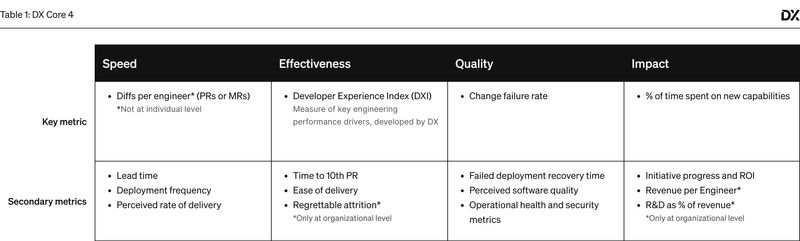
The DX Core 4 framework evaluates engineering productivity across four dimensions—speed, quality, effectiveness, and business impact—offering a well-rounded view that maps to established models like DORA, SPACE, and DevEx. It creates a consistent foundation for tracking progress over time and makes executive reporting more straightforward, helping you connect engineering activity to business outcomes and build alignment between technical priorities and organizational goals.
Armed with Core 4, you can enter your first board presentation with solid data on engineering and IT performance, meaningful comparisons to industry benchmarks, and a credible path forward. When difficult questions come up about where capacity is going, how productivity is trending, or what AI tools are actually delivering, you’ll have answers backed by data.
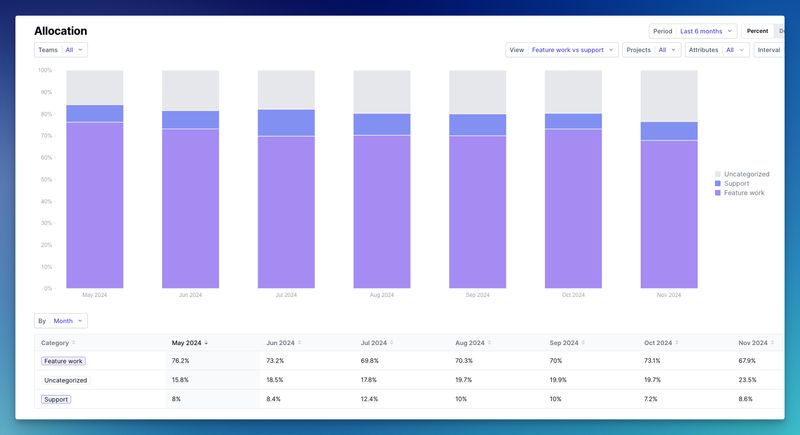
DX also helps you tackle one of the questions executives ask most: “Where is our technology capacity going?” Quarterly snapshots give you a clear accounting of how time is being spent, with visual breakdowns covering capacity consumed or freed up by AI tooling, the balance between technical debt and new investment, and whether allocation reflects stated strategic priorities.
Measuring AI’s impact
As AI tooling claims a growing share of technology budgets, leadership needs more than anecdote—they need proof. DX gives you the framework to provide it:
- Adoption metrics: See exactly which teams are using AI coding assistants and productivity tools, and surface the organizational factors getting in the way of broader uptake
- Productivity impact: Quantify whether AI tools are moving the needle on speed and effectiveness, or whether hidden friction is canceling out the gains
- Employee sentiment: Get a clear read on how developers and IT staff actually feel about the tools they’re using—whether AI is making work better or adding frustration and disruption to their workflows
- Quality implications: Keep tabs on whether AI-generated code and automated processes are holding up to quality standards or quietly accumulating technical debt and security risk
With this picture in hand, you can make strategic calls about AI with confidence—whether that means doubling down on what’s working, adjusting how tools are being rolled out, or reallocating budget toward higher-return initiatives.
Identify struggling teams or individuals
Moving quickly to spot teams that need support is one of the highest-leverage things a new CIO can do. Some teams may be underwater due to project scope, constrained resources, inherited technical debt, or difficulty keeping pace with AI-assisted ways of working. Without good visibility, it’s hard to know where to direct your attention.
DX gives you an immediate, organization-wide view of where teams are thriving and where they’re struggling—whether the issues stem from delivery pressure, quality concerns, or friction around AI adoption:

Drill-down breakdowns give you ready-to-use reports on metrics like DORA, cycle time, and throughput, sliced by team and individual:

This intelligence helps you rapidly identify where coaching, additional resources, or process changes would have the most impact. You can see exactly where AI tools are generating unexpected friction—and begin diagnosing whether the root cause is technical, cultural, or tied to how the rollout was handled.
With DX, you can direct your energy and investment where they’ll matter most, setting your teams up for sustainable performance and building a culture of operational excellence.
By the end of your first 30 days, you’ll know which teams need immediate attention, which are operating at a high level and can help elevate others, and where targeted investment will generate the strongest returns.
Your first 90 days as CIO will shape how you’re perceived as a leader and establish the foundation for everything that follows. Spending those months in passive listening mode—waiting until you have the full picture before acting—puts you in a reactive posture at exactly the moment when forward momentum matters most.
DX changes the calculus entirely. You arrive with actionable intelligence already in hand. You can step into your first board meeting backed by real data, lock in your priorities in week one, and begin making a tangible difference within your first month—all while maintaining the strategic clarity needed to make sound calls on AI investment.
The gap between a strong start and a slow one frequently comes down to information timing. Insight that arrives in month three doesn’t help you when the decisions are being made in week two. Leading with confidence from day one—when the stakes are highest and every move sets a precedent—requires having the right data when it counts.
To learn more about how DX can accelerate your impact as a new technology leader, request a demo today.