What Atlassian’s AI SDLC Index shows us about the state of engineering
Atlassian's new AI SDLC Index draws on DX data from 500+ engineering organizations.

Atlassian has launched the AI SDLC Index, an interactive experience built on data from DX pulled from more than 500 engineering organizations. Refreshed quarterly, it’s there to help you separate real industry shifts from short-term noise.
Even if you are familiar with our research, this index combines two kinds of data from DX that rarely appear together:
What developers are doing. PRs, code reviews, deploys, and AI-generated code, measured directly from engineering systems.
How developers are feeling. Survey data on what’s getting better, what’s getting worse, and what’s slowing them down.
While this Index is intended to be a destination for anyone curious about how AI is really impacting software development teams, here are three things that jumped out to me when I first got access to the dashboard.
1. Code survivorship is improving
AI-written code grew from 49% of merged code across DX customers in April 2026 to 70% in October. Over the same period, AI-code survivorship, the share of AI-authored lines still in the codebase, fell from 80% in April to 59% in September, before rebounding to 68% in October.
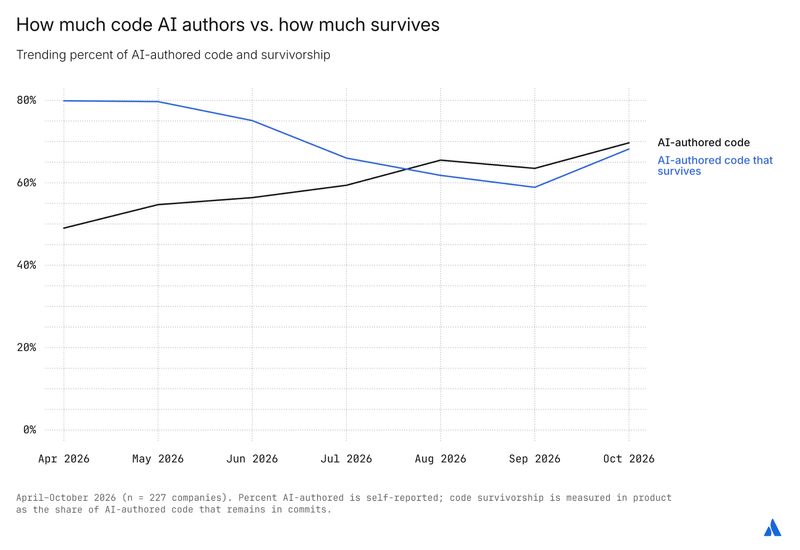
Why? Judgment about where to apply AI could be improving, both at the individual and team levels.
“At Atlassian, I’ve watched our engineers build much sharper judgment about which workflows suit automation and which suit augmentation. AI platforms are also getting better at routing tasks to the right models, and applying the most relevant context.” Atlassian CEO, Mike Cannon-Brookes writes.
At the same time, AI spend per unit of output (merged PRs, weighted by size and complexity) fell from $40 to $29, a drop of nearly 28% in October. This is the first sign that cost and quality may be improving together. One month doesn’t make a trend, but after months of spending more to get less durable code, it’s the first month where both lines moved the right way.
What to do: Stop treating the percentage of AI-generated code as a success metric. Track how much of it survives. Watch the change failure rate and review wait time. And invest in review capacity, automated testing, and CI/CD before the volume outruns them.
2. Review queues are backed up
Organizations with high AI code generation wait three times longer for a first review than those with low levels of code generation. Review capacity hasn’t kept pace with authoring capacity.
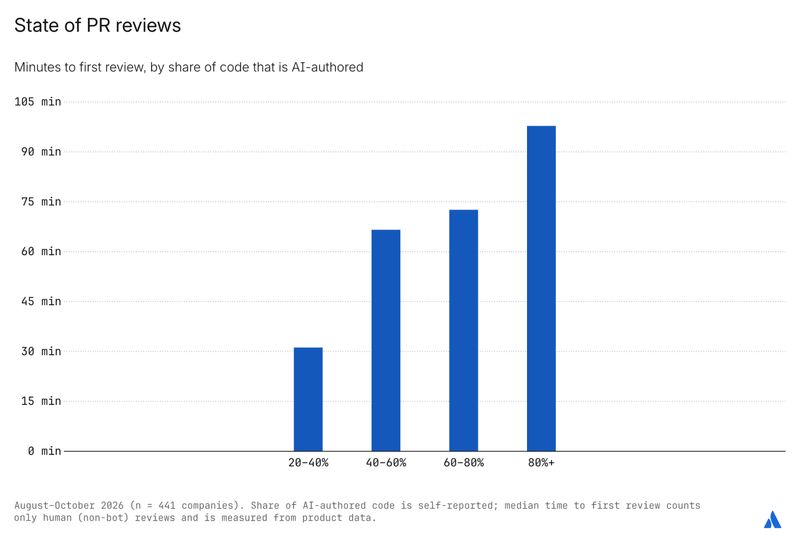
Why? AI-generated changesets tend to take more effort to review, tying up reviewers and pushing everything else back in the queue. There is also a natural inclination to avoid large, unfamiliar diffs because of the cognitive load required to get started.
“Review time was the first bottleneck we hit, but we were able to manage it differently. We built a classifier for the type of PR, and delegated the simple ones to AI. It was our biggest blocker, and we were able to remove a lot of it,” said Guillaume Roy, CPTO and cofounder at Workleap, which is a DX customer.
What to do: Cap change size through convention, tooling, or CI enforcement.
3. AI is being used for upkeep, not discovery
The large majority of observed AI usage goes to maintenance and fixes, rather than building new capability. New feature work isn’t absent, but surprisingly low considering the promise of AI coding tools.
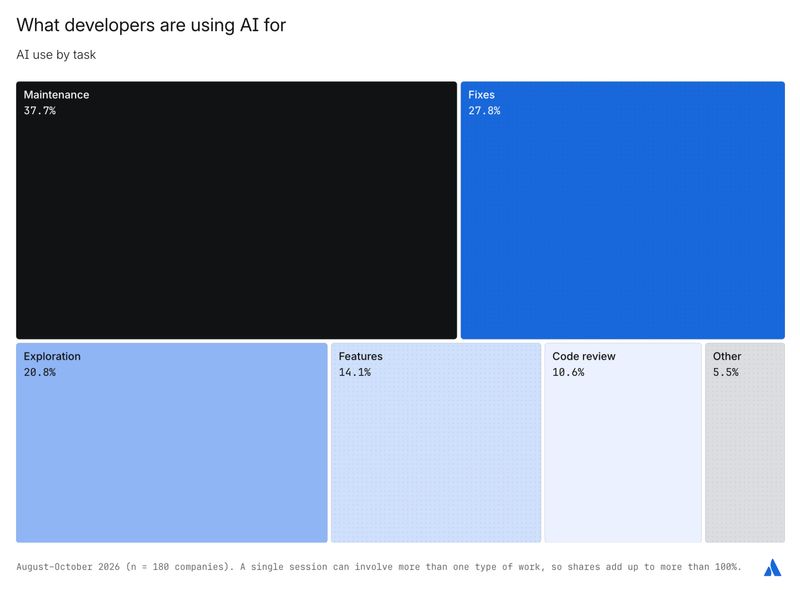
Time saved doesn’t automatically go to new work. Deciding what to build and aligning across teams haven’t gotten faster, and more code output creates more work downstream. It’s natural for developers to fill freed-up time with the well-scoped tasks already on their list.
“If people are able to do more, and the organization hasn’t shifted what activities they reward, the reasonable thing for engineers to do is check off more tasks on the lists,” says Molly Sands, Head of Atlassian’s Teamwork Lab.
This might not be a bad thing though. As Roy at Workleap put it: “We always had a massive backlog of things to fix, UX debt, small stuff. Now we just do it. Ultimately customers get a better product, because we fix the small things that were never the top priority.”
What to do: Address pipeline bottlenecks and context access to help developers move past upkeep and start to leverage tools for discovery and new feature development. Set aside dedicated time to explore, reward engineers for automating work that doesn’t need a human instead of closing more tickets, and build experimentation into team routines.
Go deeper
Explore the data: atlassian.com/ai-sdlc-index
Read the Atlassian CEO, Mike Cannon-Brookes’ analysis: What is AI changing about how software teams work?
Ready to measure your own team? Get an overview of the DX platform and request a demo.