What to do when developers say no to AI
The four types of no’s you get from developers, and how to respond as a leader.


This post was originally published in Engineering Enablement, DX’s newsletter dedicated to sharing research and perspectives on developer productivity. Subscribe to be notified when we publish new issues.
Scott: Software developer Brett Chalupa went viral three months ago for a video where he explained why he refuses to use AI in any capacity. “Whatever comes of this decision – if I get fired, if I can’t find a job, if my career as I know it is over – so be it,” he said.
Chalupa is far from alone. There are plenty of developers who would rather risk their career than allow AI models to shape the way they work. This puts leaders in a tricky position. With adoption already near universal, and optimism that AI tools can unlock new levels of productivity and creativity from software developers, industry hype is at an all-time high.
But what is driving that refusal? This week, my colleague lays out the four types of “no” engineering leaders often hear, and how to respond in each case.
Eirini: I joined DX recently as an Applied Scientist, after many years of studying how developers work, most recently at GitHub. What I enjoy most is the moment a pattern starts to make sense: why developers do what they do, and what it means for the people leading them. Right now developers’ work is changing faster than I’ve ever seen, which makes this a great time to be doing research, and I’m excited to share what I’m learning here, early and as I go.
For my first issue I wanted to write about the developers saying no to AI, and why their reluctance is worth listening to.
The last time DX’s data looked at AI adoption across hundreds of organizations, it had hit an all-time high at 93%. But that doesn’t mean that all developers are on board.
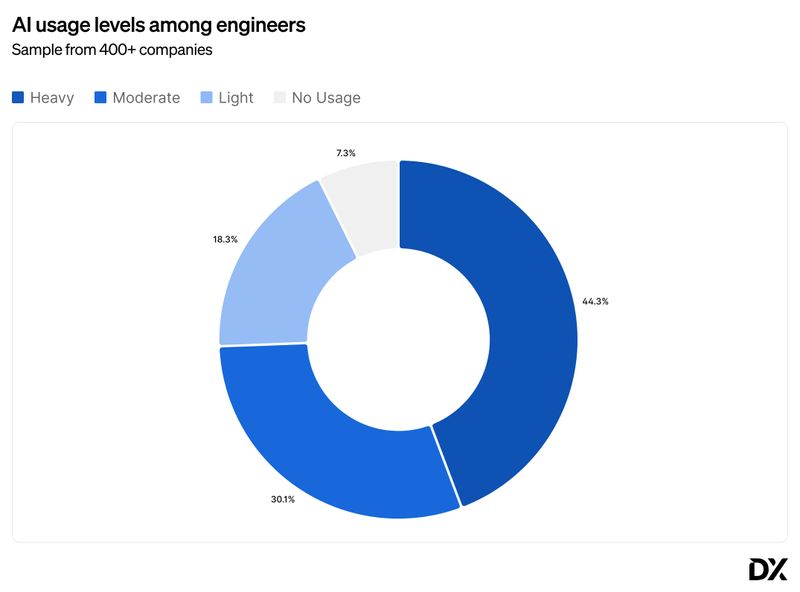
That reluctance – or even outright refusal – could even be coming from developers who use AI every day. It may be shadow AI usage, holding back on using AI in particular work, giving up on it partway through a task, or weighing it up and deciding the trade doesn’t add up for that piece of work.
When adoption is what we track, a developer who says no can look like the last part of the curve still to close. Everett Rogers, who spent decades studying how innovations spread, has warned about exactly this reading. He called it individual-blame bias: when people don’t adopt, we look for what’s wrong with them, and rarely ask what the innovation, or the system around it, failed to give them. That second question is where a no becomes useful for a leader.
What a no can tell you
Adoption might not mean impact, but it still matters at the start of an AI transformation. For that reason alone, a no that stalls adoption is worth understanding.
In an AI rollout, the organization adopts a tool, while each developer changes how they work: how they learn it, how much they check, where they let it in and where they keep it out. Early on, it makes sense for people to work much of this out for themselves. In a pilot, relying on intuition and existing experience is part of the point.
As the rollout widens, that working-out is supposed to move into the organization’s processes, systems and workflows. When it doesn’t, each developer keeps figuring it out alone, and some of them, quite reasonably, start to say no.
For engineering leaders looking to scale AI impact beyond just individual use, a no can tell you where to focus next.
One exclusion before going further. Some developers refuse to engage with AI on principle, for ethical or environmental reasons. They’re entitled to that, and there’s nothing in it for a leader to fix, so everything below is about everyone else.
Four kinds of no
Through my own research, recent studies of developers at Microsoft and across 16 organizations, and developers’ own accounts, the no’s tend to come down to four things. On a dashboard they will all look the same, but up close they are very different.
- “I don’t know how, and there’s no room to figure it out while I do my other work.” The early stretch with AI tools is messy, and it resets when a new generation of tools shows up. Results are uneven, the tools interrupt the way people are used to working, and nobody starts out knowing what good instructions or good context look like. The developers we interviewed who became highly fluent learned it by getting burnt and adjusting, and every one of them started out skeptical. What carried them through was urgency, and some fear of being left behind. Part of not knowing how to work with AI is also not yet seeing what a developer’s work becomes once an agent does some of what they used to do. Many developers try, find it slower and more frustrating than the way they already know, and go back to what works. That’s a sensible response to a learning curve that doesn’t come with time set aside for it.
- “I’ve weighed it, and it doesn’t add up.” This no often comes from people who use AI well. They see real gains, and they also see where the costs are: more output to review, skills they practise less, less of the work they enjoy, and expectations that rise because the tools exist. So they decide, task by task, where the trade off is worth it and where it isn’t. Of the four types of no, this is the one most easily mistaken for resistance, and it is the most deliberate. These developers are already fluent, and their sense of where it pays off and where it doesn’t is something the organization can learn from.
- “I can’t stand behind it.” Developers’ names are on what ships, so they weigh how risky a change is, how reversible, and how much checking it will take. When they hold back, it is usually because they can’t check what was produced well enough to own it, or because there is more of it than they can review. Developers tend to trust AI output when it is easy to verify, and much of the work that matters has edge cases and exceptions. The instinct here is right, and it gets stronger as more of the code in front of them was written by something else.
- “It was decided without me.” Sometimes the no is about how AI arrived. Which tool, how much use is expected, which work it’s required for. At the far end are usage targets and leaderboards. Being told which tool to use can feel like being told how to do your job, and much of this no would show up with any mandate delivered that way, AI or not.
Most reluctance is a mix of the above, and the same developer can give a different reason for different work. Someone who has never started and someone who uses AI every day can give the same no. So it is more useful to look at the reasons than to sort the people, and only the people saying no can tell you which reasons are theirs.
The layer underneath
What strikes me when developers explain a no is how rarely they are talking about the tool. They talk about what they own, what they are good at, and who decides how their work gets done. In my research for The AI-Native Developer, the developers deciding where AI was applied in their work were protecting the parts that made it worth doing.
That is close to what motivation research has described for a long time. Self-Determination Theory, one of the most studied accounts of motivation at work, describes the three needs people have: autonomy, competence, and relatedness. When those needs are met, people commit to a change because they see the point of it. When they aren’t, you can still get compliance, but not the kind of commitment the later benefits depend on.
We already talk about AI readiness in rollouts, usually in terms of systems, data, procurement and security. Each of those can stall a transformation, and nobody rolls out without checking them. I think motivation belongs on that list. It’s harder to see, and it can block progress too. But notice how we respond. When a system isn’t ready, we investigate. When a developer says no, we are more likely to push.
You can hear the first two needs in what developers say: “it was decided without me” is about having a say in how you work (autonomy), and “I don’t know how” is about being good at the work and staying good at it (competence). The third need, connection to the people around you (relatedness), rarely comes up as a reason, but it shows up elsewhere: developers describing AI as making their work easier and lonelier. That deserves its own investigation.
The gap behind each no
Each kind of no can point to a gap: something the developer is compensating for because the organization hasn’t put it in place yet. As long as individuals are compensating, whatever they gain mostly stays with them, and it’s hard to see at the organization level. Here is where you can start looking for each kind of no.
Room to learn. Learning how to leverage AI in daily work is something that needs to happen regularly, alongside the evolution of tools and the emergence of new practices. When learning is left to each person, the organization pays for it many times over. Every developer faces each challenge separately, and what one of them figures out rarely reaches the next. Closing this gap means two things. Time to learn inside the work, so it isn’t squeezed in around it. And a way for what people learn to travel, so the patterns that work become shared practice. Some organizations, Snowflake among them, run regular focus weeks and turn what their engineers found into patterns everyone can use.
Accountability. Today the decision about how much review a change needs is usually left to the developer, one change at a time, while the amount to review keeps growing. What’s missing is a decision the organization makes and curates over time: which kinds of work can move with lighter review, which still needs someone who understands the change fully, and what gets checked automatically before a person looks. I’d make that call with the same questions developers already ask themselves: how risky the work is, and how reversible.
Work design. This gap has two parts. One is what the fourth no is about: decisions made without the people they affect. The other is the processes that need to adapt. As more of the code comes from AI, review grows, handoffs shift, and the time saved on writing code goes into directing and checking AI output, work that rarely shows up in anyone’s plan. Both parts land on the developer, and neither has an owner.
Fit. Often there is no coordinated effort to identify, for the organization as a whole, where AI pays off and for which work. So each developer runs that evaluation alone, and what they find never adds up to a view the organization can use. The result is uneven use across teams. Closing this gap means collecting what people have found about where AI works for each type of task (writing tests, say, or migrating legacy code), and accepting that for some kinds of work the answer will be that AI doesn’t pay off yet. It also means asking again as the tools change, because the answer for a given kind of task won’t stay the same for long.
Where to start
Here’s where I think there is leverage for leaders.
Listen for moments. It is always good advice to have good listening mechanisms for your developers. In this case you want to ask, in a blameless way, about examples of choosing not to use AI for something, and why. Asking about a specific moment gets you the situation and the reason, and it works whether the person uses AI every day, or hardly at all. The reasons will point to the gaps. If use is tracked or required, how you ask matters as much as what you ask. People need to be able to answer honestly, so think about anonymity and about who does the asking.
Redesign the work with the engineers who do it. Start from the challenges the no’s brought up. If you can, bring in the engineers who ran into those challenges and held back. They will give you more nuanced requirements, and they will show you constraints you wouldn’t otherwise see. For that to work, the redesign has to be allowed to conclude that some work isn’t ready for AI yet.
Final thoughts
The developers saying no are often the first to run into what a rollout hasn’t put in place yet. That makes their reluctance one of the earliest signals a leader gets, and it’s worth treating the way we’d treat any other readiness problem: by finding out what’s behind it.
It also helps to remember who is saying no. Often it’s people who care about the work and want to keep doing it well, which is exactly who you want shaping how AI fits into it. Handled well, a no is where a more useful conversation about AI can start.
One more thing
We published an article earlier this week about how the HR tech company Workleap quadrupled engineering velocity across 120 developers by using DX telemetry to measure and defend AI investments.
“Without the data from DX, executive discussions around our $3 million token spend would have been purely defensive. Having real-time data allowed us to prove that moving faster was delivering tangible value to the business.” said Guillaume Roy, Chief Product and Technology Officer, Workleap.