New DX data finds 94% of AI token usage is re-reading existing context
DX’s Q3 2026 AI Impact Report shows how AI's speed gains are moving through the delivery pipeline
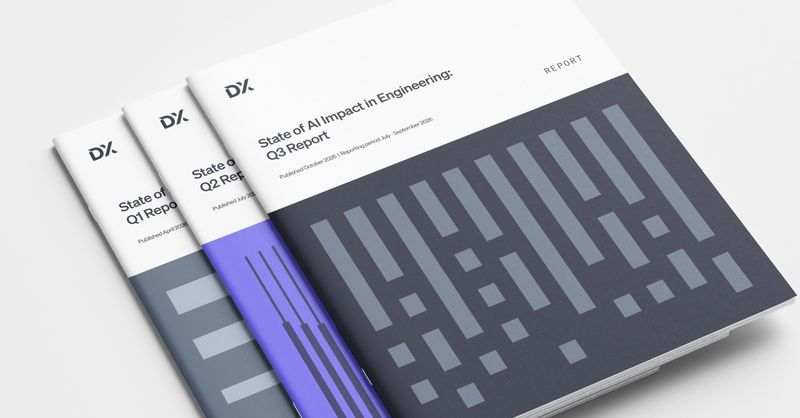
October 14, 2026 — Today, DX published the State of AI in Engineering: Q3 2026 report. Across data from 500+ organizations, DX found that total AI spend grew 106% from Q2 to Q3, but a growing share of that investment is spent re-reading existing context rather than generating new code. Meanwhile, the code that does get produced is overwhelming downstream review processes.
In organizations where 80% or more of code is AI-authored, the median wait for a first review is 82 minutes. Median PR size is up 122% year over year, so reviewers have far more code to get through with the same capacity.
Key findings from the Q3 2026 report
- AI spend growth is slowing, but volume keeps rising. Total AI spend grew 106% from Q2 to Q3, compared with 342% the quarter before. Median cost per million tokens stayed between $0.58 and $0.78 all year. Cache-read tokens reached 94% of total token usage.
- AI sessions skew toward upkeep. This finding comes from DX’s AI Code Insights, which captures how teams actually use AI coding tools instead of inferring it from output. DX then classifies each session by the type of work done. About 33% of sessions went to maintenance and 23.3% to fixes. Only 11% went to building new capabilities.
- Delivery volume is still growing. Median weekly TrueThroughput rose 75.5% over four quarters, from 1.43 to 2.51 PRs per developer. Q3 growth was 19.0%, the first quarter it dipped below the roughly 20% pace of the past year.
- Developers feel faster on tasks but not on delivery. The biggest reported gains were in production debugging (+13.3%), documentation (+10.4%), and build and test (+10.4%). Perceived ease of delivery improved by only 3%.
- Quality is steady, with one number to watch. Change failure rate and failed deployment recovery time stayed roughly flat. The median quarter-over-quarter change in change failure rate moved from 0% to +0.5%. That shift isn’t statistically significant yet.
Mapping Core 4 friction to the CAFE(S) framework
This is the first quarterly report to use CAFE(S), the context quality framework DX co-authored in ACM Queue in September. The report connects each DX Core 4 friction point to the context failures most likely to cause it. CAFE(S) represents five dimensions: Clarity, Actionability, Fidelity, Efficiency, and Security. This quarter’s mapping is a diagnostic starting point rather than a set of measured results.
The report also includes recommendations for engineering leaders: Measuring review capacity alongside authoring capacity, limiting change size, automating verification before code reaches a reviewer, and writing down architectural intent where AI agents can access it.
The State of AI Impact in Engineering: Q3 2026 Report is now available.